
The Crosswind Man
An Unofficial Guide for New First Officers

Read Before Your First Red-Eye
“Read this before your first red-eye. It’s probably nonsense. But if your captain ever tells you to leave the autopilot alone for a few seconds after it disconnects… don’t argue.”
— Anonymous Check Airman, photocopied note found in an old flight bag, 1987
On Labyrinthia Mythweaver and John Watson - Horror Author ’s prompt. To build a cryptid character but also a legend. Here’s my take and thanks guys for having this prompt it was so fun!
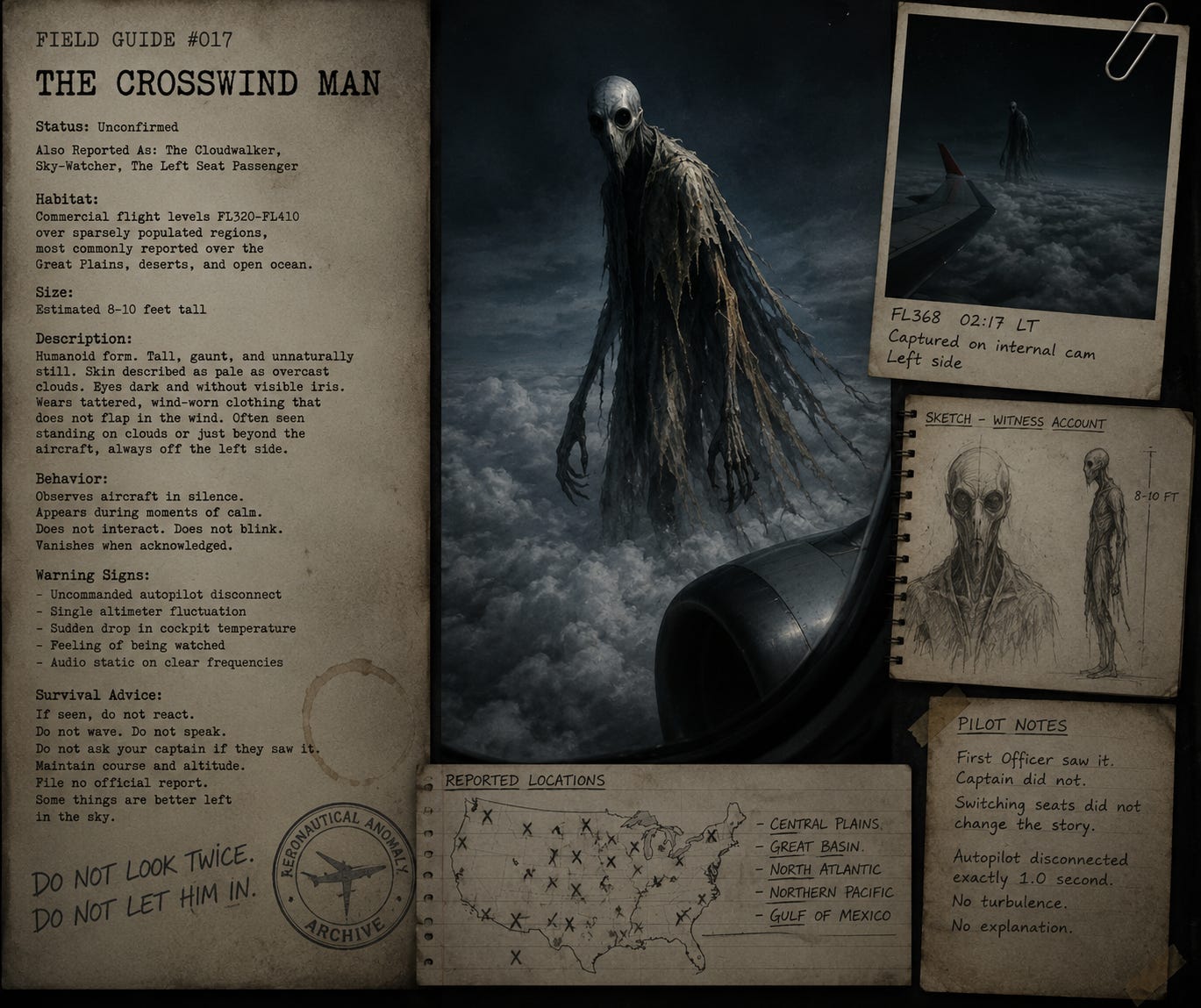
The Crosswind Man
Every airline has stories. Some are about impossible crosswinds, haunted layover hotels, or captains who somehow managed to taxi away with the parking brake still set. Those stories usually grow a little taller every time they’re told, becoming part of the humor that binds pilots together. This one is different. It never seems to change. Nobody remembers who first spoke of the Crosswind Man, and nobody openly admits they believe he exists, yet every airline, freight operator, military squadron, and bush pilot seems to know some version of the same tale.
Pilots who have never shared a cockpit, flown for the same company, or even worked on the same continent somehow describe the same unsettling encounter. The older captains rarely volunteer the story. They wait until someone else mentions it, and when they do, their smiles tend to disappear for just a moment before they quietly change the subject.
The younger pilots usually laugh, but they also tend to be the ones who haven’t spent enough nights above the clouds.
What Is He?
That question has been asked for decades, and nobody has ever managed to answer it. Every witness remembers something different. Some swear he wore an old leather flying coat from another era, while others describe a long black overcoat hanging perfectly still despite the wind rushing past the airplane at nearly six hundred miles an hour.
One retired Air Force pilot insisted antlers reached into the darkness above his head like the branches of a dead tree, while a cargo captain described enormous wings folded neatly behind his back that never once moved.
A mechanic in Denver once recalled a captain who refused to describe anything except the eyes, claiming they looked unsettlingly familiar without ever explaining why.
The strangest account came from a check airman who quietly admitted the Crosswind Man looked exactly like him, only older, more weathered, and carrying the exhausted expression of someone who had been waiting an impossibly long time.
Every description contradicts the one before it, yet every witness agrees on two impossible details. He is always standing upon the clouds as though they were solid ground, and he is always watching the airplane. No witness has ever claimed he blinked.
When He Appears
No credible story has ever placed the Crosswind Man inside a thunderstorm, severe turbulence, or an emergency. He seems to belong only to those strange hours of the night that every long-haul pilot eventually learns to recognize. The passengers are asleep, the cabin lights are dimmed, the radios have grown quiet, and the engines have settled into that steady hum that makes it easy to forget an airliner is crossing the continent at nearly the speed of sound.
Somewhere between one and four in the morning, when the cockpit feels detached from the rest of the world, the first sign almost always arrives. It isn’t a shadow outside the window or an unexpected movement in the clouds. Instead, it begins with a single mechanical click as the autopilot disconnects without warning. There are no caution lights, no faults to troubleshoot, and no maintenance discrepancies waiting to be written after landing. It simply disengages for a heartbeat before reconnecting as though nothing unusual had happened.
It is only afterward, almost absentmindedly, that someone glances out the captain’s window and sees a solitary figure standing motionless upon the clouds, watching the airplane drift silently past.
⸻
The Rules
Nobody knows where the rules came from, yet nearly every senior captain seems to know them. They are never taught during training, printed inside an operations manual, or mentioned during simulator sessions. Instead, they survive the way old folklore always has, passed quietly from one generation to the next over stale hotel coffee, late-night van rides, or empty crew rooms after long duty days.
If the conversation ever drifts toward the Crosswind Man, the room tends to grow noticeably quieter before someone inevitably repeats the same warnings. They will tell you not to point, not to wave, and never to shine the landing lights toward him, because nobody has ever agreed on whether acknowledging him is an invitation or a mistake. They will also tell you never to ask the other pilot if they can see him. If they saw him too, they’ll speak when they’re ready. If they didn’t, you’ve just guaranteed they’ll spend the rest of the flight searching every cloud outside the cockpit. Some captains add one final piece of advice before changing the subject entirely.
If the autopilot disconnects by itself, count slowly to five before turning it back on. Nobody has ever explained why, and nobody who follows the rule has ever admitted what they expected to happen during those five seconds.
⸻
The Stories
The unsettling part isn’t that pilots claim to have seen the Crosswind Man. Aviation has never been short on strange stories. The unsettling part is how remarkably similar the accounts remain, even when the people telling them have never met.
A Southwest captain crossing western Kansas once dismissed the figure as moonlight playing tricks on tired eyes until it slowly turned its head and followed the airplane with an unbroken gaze. He chose not to mention it, convinced fatigue had gotten the better of him, until twenty minutes later his first officer quietly asked, without ever looking up from the checklist, whether he had remembered to leave the autopilot off long enough. Neither pilot spoke another word about the encounter.
A FedEx crew crossing the Atlantic completed their shutdown checklist in complete silence after landing in Cologne. According to the mechanic who met them at the gate, the captain looked at his first officer just before climbing down the stairs and asked only one question. “How close did you think he was?” Neither pilot ever accepted another ocean crossing together, and neither ever explained why.
A retired Air Force pilot claimed he first saw the Crosswind Man while flying over Afghanistan in 2003. Nearly twenty years later, now carrying passengers across the American Midwest, he encountered the same impossible figure standing upon the clouds over eastern Colorado. Different aircraft, different continent, different life, yet the silhouette never seemed to age. When someone eventually asked what he believed the Crosswind Man wanted, he stared into his coffee for a long time before quietly answering that the figure had never been watching the airplane. He had been watching one of them.
The Part Nobody Likes Talking About
Most captains will tell you the Crosswind Man has never harmed anyone, and they are probably telling the truth. They will also become noticeably uncomfortable if you ask what happens after the first sighting, because that is the part of the legend nobody enjoys repeating.
According to the oldest versions of the story, anyone who claims to have seen the Crosswind Man eventually sees him again. Sometimes the second encounter comes months later. Sometimes it takes decades. It is always another calm night, another quiet cockpit, another effortless cruise above an endless sea of clouds. The only detail that ever changes is the distance. Every subsequent sighting places him just a little closer than before.
Nobody agrees on what happens if he ever reaches the airplane, and no one who has claimed to know has ever finished telling that part of the story.
One Last Thing
Over the years I’ve asked more old captains than I can count whether they believed the Crosswind Man was real. Every one of them smiled, every one of them looked away for a moment, and every one of them found a reason to change the conversation before answering. I’ve started to wonder if that silence is the only part of the legend everyone truly agrees on.
If you happen to hear a single mechanical click on a calm night somewhere above thirty-seven thousand feet, you’ll probably tell yourself it was nothing more than the autopilot doing something strange. You’ll glance out the captain’s window because that’s what every curious pilot eventually does, and you’ll probably laugh if you don’t see anything at all.
Most first officers do.
The captains usually don’t.
The escalating distance, every sighting placing him closer than the last, is what actually builds the dread here. That closing split between laughing first officers and silent captains is exactly the right way to end a legend.
Absolutely brilliant. It has a real "After a few pints at an old pub with a log fire" vibe; the kind of place where old stories are told. Love it!