
Every Sunday
Sunday Scaries #003

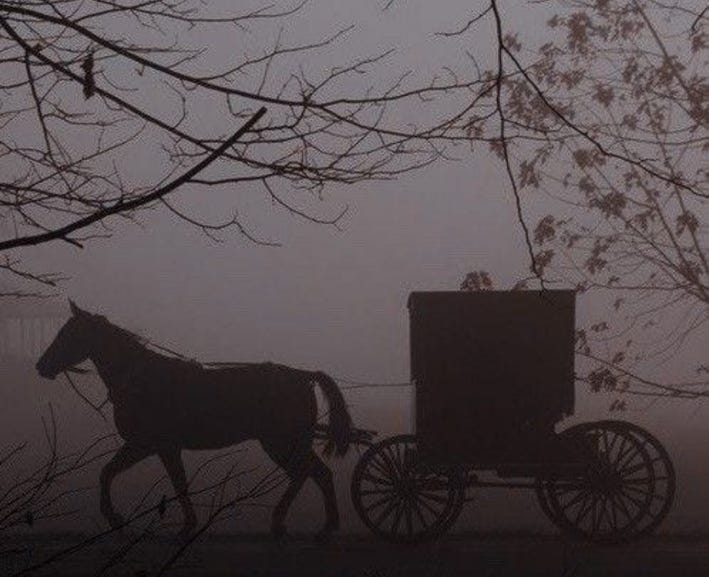
The image above is this week’s Sunday Scaries prompt by Labyrinthia Mythweaver , Mat the Horror Poet , and Conor MacCormack and what follows is where it took me.
My grandfather left a cup of coffee out every Sunday morning for so long that I honestly can’t remember when I first noticed nobody ever drank it. I think I assumed somebody was always about to show up. Kids are good at inventing explanations for things adults stop questioning. If there’s an empty chair at the table, somebody must be running late. If a porch light stays on all day, somebody must have forgotten it. Grandpa poured two cups before sunrise every Sunday, carried them both onto the porch, drank one while the other slowly cooled beside him, and never acted like there was anything unusual about it. After enough years it became part of the farm the same way the windmill squeaked in a north wind or the screen door slammed too hard if you didn’t catch it with your foot.
Sunday mornings always felt different out there. Grandma would already be inside making breakfast, my parents would be getting ready for church, and Grandpa and I would sit on the porch watching the fields wake up. Most of my childhood memories of him involve silence. We weren’t the kind of family that needed to fill every quiet moment with conversation. Sometimes we’d sit twenty minutes without saying anything at all and it never felt awkward. He’d sip his coffee, I’d swing my boots against the porch rail, and eventually the sun would burn the last of the fog off the pasture. Then he’d stand up, carry both mugs back inside, wash them, and the day would begin.
It wasn’t until I was eight or nine that I finally asked about the second cup. He didn’t even look at me. He kept watching the road and said it was for an old friend. I accepted that answer because children accept almost everything adults tell them if it’s delivered confidently enough. I remember looking down the driveway expecting another truck to pull in, but none ever did. The cup sat untouched until Grandpa finished his own, and when he carried them back inside one was empty while the other was still almost too hot to hold. That happened every Sunday I can remember, and after a while I stopped asking because routine has a funny way of making strange things feel ordinary.
The older I got, the more I realized every family carries around little rituals nobody can explain anymore. Some people say the same prayer their grandparents said without knowing what half the words mean. Some leave an empty chair at Thanksgiving because that’s just how it’s always been done. We had two cups of coffee on Sunday mornings. It wasn’t spooky or mysterious. It was simply part of the furniture of my childhood, another detail that blended into the background until I left home and realized other families didn’t do things the same way.
I moved away for college, got married, raised kids, and settled into the kind of life that only lets you visit home a few weekends a year. Every time I came back the farm looked a little smaller than I remembered and Grandpa looked a little older, but Sunday mornings never changed. I’d wake to the smell of coffee, wander onto the porch still half asleep, and find him in the same chair with two mugs waiting on the table between us. He’d slide one toward me without a word, keep the other where it was, and we’d watch the fields while the coffee cooled. I don’t think I ever saw him pour that second cup out. It would simply disappear when we went back inside, and by lunchtime I wouldn’t think about it again.
If you’d asked me back then what made my grandfather unusual, I probably wouldn’t have mentioned the coffee. I’d have talked about the way he whistled while fixing fences or how he could tell it was going to rain six hours before the weather radio caught up. The coffee wasn’t remarkable because it had always been there. It took distance to realize habits can be stranger than events. Somewhere along the way I also noticed something else I’d somehow ignored my entire childhood.
Every Sunday, just after sunrise, an old horse and buggy rolled past the front of the farm. I don’t mean once in a while or during some annual festival. I mean every Sunday. Rain or shine. Winter or summer. It crossed in front of the property at the same slow pace and disappeared over the next hill without ever stopping. There wasn’t anything theatrical about it. No rattling chains or ghostly horses or impossible fog clinging to the wheels. It looked so ordinary that if you passed it on a back road you’d probably assume somebody was taking the scenic route home from church. Black horse. Black buggy. Curtains drawn over the windows. A driver sitting straight with the brim of a dark hat low enough that I never once remember seeing his face.
What strikes me now is how little attention I paid to it growing up. Kids normalize whatever the adults around them normalize, and Grandpa never stared or pointed or made a big deal out of it. He watched it pass the same way you’d watch geese flying south in October. Eventually I asked who was inside.
“Never mattered.”
I asked my dad about it once years later and got the strangest look I’d ever seen from him. He asked what buggy I was talking about. I pointed toward the road and he looked out the window for a second before telling me there hadn’t been horses on that road since he was a kid. Grandpa was sitting three feet away listening to the conversation, but instead of correcting either of us he took another sip of coffee and watched the sunrise. I remember thinking they were playing some joke I wasn’t old enough to understand. I didn’t think about it again until years later, when I started wondering if the buggy belonged to Grandpa in a way the rest of us couldn’t see.
It wasn’t until a few years before he died that I asked him the only question that ever seemed worth asking.
“Did you ever look inside?”
He didn’t answer right away. The buggy hadn’t come yet, and the morning was so still I could hear the old coffee maker click off inside the kitchen. He kept staring down the road until I almost repeated myself, then finally nodded once.
“Once.”
Naturally I asked what he’d seen, and for the first time in my life I watched my grandfather struggle to find words. He wasn’t frightened. He looked sad.
When he finally spoke, he never took his eyes off the road. “If I told you,” he said, “you’d spend the rest of your life waiting for it to come back.” He finished his coffee, carried both mugs inside, and never mentioned the buggy again.
He died six months later.
The first Sunday after the funeral I woke before sunrise without setting an alarm, wandered into the kitchen still thinking about him, and made coffee the way I’d watched him make it for thirty years. I didn’t realize what I’d done until I was standing there with two mugs in my hands. I remember staring at them for a long time, telling myself to pour the second one back into the pot because habits aren’t inheritances and grief makes people do strange things. Instead, I carried them onto the porch and sat down to watch the road.
For the first time in my life, I found myself wondering how much longer it would be before the buggy came.
The first few Sundays after the funeral I didn’t think much about the second cup. Grief makes people repeat old routines without realizing it, and pouring too much coffee seemed healthier than talking to an empty room. I’d carry both mugs onto the porch, sit in Grandpa’s old chair, and watch the road until the buggy appeared. It always did. Same black horse. Same closed carriage. Same slow pace that somehow never looked hurried or delayed. It rolled past the farm exactly as it had my entire childhood while the second cup slowly lost its steam beside me. Afterward I’d carry both mugs back inside, pour the untouched coffee into the sink, and spend the rest of the afternoon feeling vaguely embarrassed by the whole thing.
The habit lasted longer than I expected. One month turned into three, three into six, and before long I quit pretending I was going to stop. Nobody knew except me. If family came over later in the day, the extra mug was already washed and back in the cabinet. As far as anyone else knew, Sunday mornings were no different than they’d ever been. I think that’s how traditions survive. They don’t get passed down through speeches. Somebody simply keeps doing something until they can’t remember making the decision in the first place. The first crack in that explanation came by accident.
I overslept one Sunday after spending most of Saturday repairing a section of fence that should’ve been replaced twenty years earlier. By the time I stumbled into the kitchen it was almost eight. The coffee maker was empty because I hadn’t programmed it the night before, church traffic was already drifting down the highway a mile away, and for the first Sunday in my life I realized the buggy had probably come and gone without me seeing it. I shrugged, made breakfast instead, and didn’t think about it again until later that afternoon when I happened to look toward the road and caught myself wondering what time it had passed.
The following week I was back on the porch before sunrise with two cups, mostly because I felt guilty for missing what had quietly become part of the rhythm of the place. The buggy appeared right on time. Nothing unusual happened. It passed the farm, disappeared over the hill, and left me feeling slightly foolish for caring in the first place. If the story ended there, I’d probably still laugh whenever I thought about Grandpa and his old friend.
A couple of Sundays later my daughter stopped by with my grandson after church. He wandered onto the porch while I was washing dishes and pointed at the little table between the rocking chairs.
“Where’s the other cup?”
I asked him what he meant.
“The one Grandpa always leaves out.”
For a second I thought he meant me. Then I realized he was talking about my grandfather, a man he’d barely known before he died. Kids say strange things all the time, so I told myself he’d heard family stories and mixed them together in his head. He accepted that explanation a lot easier than I did and ran off toward the barn chasing the dog. That night I found myself lying awake thinking about it.
The next Sunday I decided to prove to myself that I’d turned an old family habit into something bigger than it was. I poured one cup instead of two, carried it onto the porch, and sat in Grandpa’s chair watching the sunrise with the empty table beside me. I remember feeling ridiculous, like a grown man trying to win an argument nobody else knew he was having.
The buggy never came.
I waited nearly an hour before going back inside. I even walked to the mailbox afterward just to convince myself I’d somehow missed it, but the road stayed empty all morning. By Saturday night I’d already decided to pour two cups again.
I wish I could tell you it was because I wanted to prove myself wrong one last time, but that wouldn’t be true. Somewhere between washing the dishes and setting the coffee maker before bed, I’d started thinking about the empty road the way you think about a song that stops before the last note. The buggy had been part of Sunday mornings for as long as I could remember, and spending an entire day without seeing it left the farm feeling incomplete, like somebody had forgotten to ring the church bell.
So I made two cups, carried them onto the porch, and twenty minutes later the buggy came over the hill. Same horse. Same black carriage. Same driver sitting perfectly still with his hat pulled low.
I remember laughing out loud, partly because I’d been right and partly because I hated how relieved I felt. If somebody had driven by and seen me sitting there grinning at a horse and buggy, they’d have every right to think I’d finally lost my mind. By the time it disappeared over the hill, I’d already decided the whole thing had been coincidence.
The next Sunday I tried one cup again.
I stayed outside until the coffee was cold enough to pour into the grass. I walked all the way to the mailbox and stood there staring down the road long enough for my neighbor to stop and ask if I was waiting on somebody. I told him no, just getting some air. He nodded like that made perfect sense and drove on. The road stayed empty. After that I quit telling myself it was coincidence.
I didn’t tell anybody else either. People imagine secrets are hard to keep, but most of them are surprisingly easy. You simply stop bringing them up. My daughter talked about work. My grandson talked about baseball. The neighbors complained about taxes, coyotes, and the price of feed. Every conversation gave me another chance to say, “By the way, I think an old horse and buggy only comes by if I leave a second cup of coffee on the porch,” and every time I chose not to. Some thoughts sound ridiculous the moment they leave your mouth. Instead I started paying attention.
The coffee had to be outside.
I figured that out by accident one Sunday when the phone rang just as I was carrying the mugs to the porch. By the time I’d finished talking and sat down, I’d forgotten the second cup was still on the kitchen counter. I waited almost half an hour before realizing it, walked back inside feeling embarrassed with myself, and carried it out muttering that I was acting like a fool. Five minutes later the buggy came over the hill. I spent the rest of the day trying to convince myself I’d simply been lucky with the timing.
The strangest part was how quickly it became normal again. Every Saturday night I’d rinse out two mugs and leave them beside the coffee maker. Every Sunday I’d wake before the alarm, carry them onto the porch, and sit in Grandpa’s chair watching the road wake up. Some mornings I’d think about him. Some mornings I’d think about nothing at all. The horse would pass. The buggy would disappear over the hill. I’d carry one empty mug and one full mug back inside.
Life happened in between.
The roof needed replacing. The old oak by the barn finally came down in a storm. My grandson got old enough that he stopped chasing the dog around the yard and started asking if I needed help stacking firewood. Every year the farm changed a little, and every Sunday morning nothing changed at all.
I didn’t realize when I stopped waiting for the buggy. I only realized I’d started expecting it. That didn’t become clear until one October morning when I looked at the clock and saw seven-thirty. The porch was empty. The coffee maker was still full.
For the first time in years I’d slept through sunrise.
I don’t think I’d ever gotten dressed faster. I poured two cups with hands that shook more than I cared to admit, carried them onto the porch, and sat down trying to catch my breath. The road stretched away in both directions without another soul on it. I kept telling myself I’d missed it, that the buggy had come and gone while I slept, and that would be the end of it. Then, almost half an hour later, I heard the slow rhythm of hooves on gravel. The buggy came over the hill exactly as it always had.
Only that morning, for the first time I could ever remember…it was waiting on me.
After that I stopped trying to understand it. I’d spent years looking for a reasonable explanation and every answer only led to another question until the questions became more exhausting than the ritual itself. I made two cups. I carried them onto the porch. The buggy passed. I carried one empty mug and one full mug back inside. There are worse ways to spend a Sunday morning.
He started coming over on Sunday mornings after high school. Never for long. Just long enough to drink a cup of coffee before heading into town. Sometimes we’d talk about work. Sometimes football. Most weeks we’d sit in silence watching the sun work its way across the pasture until the buggy rolled over the hill. I never pointed it out. He never mentioned it. After a while I stopped wondering whether anyone else could see it. It was enough that I could.
One Sunday he asked why I always made two cups. The question caught me off guard because I’d forgotten there was anything unusual about it. I looked at the second mug for a long time before answering.
“It’s for an old friend.”
He nodded the way children do when adults say something they don’t understand, took another sip of coffee, and changed the subject. For the rest of the morning I couldn’t shake the feeling that I’d heard those words somewhere before.
The years after that blur together the way old photographs do. Names fade first. Dates disappear. You remember the feeling of a morning better than the morning itself. I remember frost on the fence posts, the smell of cut hay drifting across the road, and the sound of my grandson laughing from the barn when he thought I’d dropped another board on my foot. More than anything, I remember every Sunday beginning exactly the same way. Two cups. Two chairs. One buggy.
Then one October morning the buggy didn’t come. I waited longer than usual before admitting something was wrong. The coffee beside me had gone cold. Church traffic had already disappeared down the highway, and the shadows had shifted across the porch. For the first time in decades the road stayed empty. I should’ve gone inside. Instead I made another pot of coffee. I carried two fresh cups back onto the porch and sat down again. The horse appeared almost an hour later than it should have.
It walked slower than I’d ever seen it walk, pulling the buggy to a stop in front of the gate before lowering its head as if it had finally reached the place it was meant to be. Nothing happened. No voice called out. No curtain moved. The morning stayed so quiet I could hear the coffee cooling beside me. Then the buggy door opened.
I don’t know how long I stood there. Long enough for my knees to complain. Long enough for the horse to flick its tail once. Long enough to realize I wasn’t afraid. I’d spent my whole life wondering what Grandpa had seen inside that carriage. By then I understood he’d never been warning me about what was inside. He’d been warning me about the waiting. I walked down the porch steps without hurrying.
When I reached the open door, I looked inside. Then I laughed. Not because anything was funny. Because after all those years there wasn’t a single thing inside that surprised me. The next thing I remember is my grandson standing on the porch calling my name because the coffee had gone cold. He looked worried. I smiled at him and told him I’d be there in just a minute. He nodded, picked up both mugs, and carried them back into the house. I don’t remember much after that morning.
The farm was sold a few years later.
Or maybe it wasn’t.
That’s the part I can’t seem to hold onto anymore. Some mornings I remember signing the papers, shaking the buyer’s hand, loading the last boxes into the truck, and looking back at the porch one final time before driving away. Other mornings I remember never leaving at all, sitting in Grandpa’s chair with two cups of coffee between us while we watched the buggy come over the hill. The strange thing is both memories feel equally real.
For a long time I blamed age. Everybody forgets things eventually. You walk into a room and can’t remember why. You misplace your keys. You call your grandson by your son’s name. Then little things started happening that didn’t fit. One Sunday my grandson asked why I always poured two cups, and I answered before I even thought about it.
“It’s for an old friend.”
The words came so naturally I didn’t question them until after he’d gone home. I’d heard them before. I could hear Grandpa saying them as clearly as if he were still sitting beside me. I just couldn’t remember whether I’d ever believed him.
After that the memories kept slipping. Sometimes I’d wake before sunrise with coffee already brewing. Sometimes I’d find two clean mugs beside the pot with no memory of washing them the night before. Once I stood on the porch for nearly an hour trying to remember whether the buggy had already passed or whether I was still waiting for it. I knew the answer mattered. I just couldn’t remember why.
My grandson still comes by on Sundays. We sit together the way Grandpa and I used to, talking some mornings and saying nothing at all on others. Last week he looked over at me and asked if I’d ever looked inside the buggy.
I wish I could tell you what I said.
I wish I could even tell you whether he was the first person to ask me.
Instead I found myself staring at the road, trying to remember a morning from forty years ago. I could smell the coffee. I could hear a little boy’s voice. I could see an old man watching the sunrise. I just couldn’t remember which one of us I was.
He must have thought I’d fallen asleep because he stood up, picked up both mugs, and carried them toward the house. I watched him go, and for just a second the way he crossed the porch looked so familiar it made my chest hurt. A minute later he came back outside, glanced at the empty chair beside me, then looked down at the second mug.
He frowned.
“Grandpa… I don’t remember pouring this one.”
I looked down too.
Mine was still full.
The other one was empty.
I’ve been trying to remember which cup I drank ever since.
Next Sunday we’ll be back before sunrise.
I know there will be two cups on the table.
I’m just not sure anymore which one has always been mine.
I love a good atmospheric, ambiguous story. Those stick with you the longest because they haunt you far more. An innocent ritual that slowly bleeds into the next generation with no explanation feels like the blending of a Twilight Zone episode and a Ray Bradbury story, though I believe he did write some episodes. Still, it has the wonderful chills of an American Gothic tale.
I was engrossed from start to finish.
Loved this. So eerie and nostalgic.